
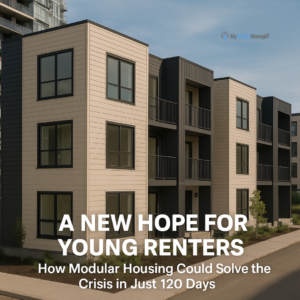
Across the world, young people are being priced out of the rental market and Israel is no exception. From students to early-career professionals, millions face a frustrating cycle: long waitlists, soaring rents, and limited availability in neighborhoods they want (or need) to live in.
But what if the solution didn’t require building massive developments over 3–5 years?
What if entire communities could be built in months not decades?
According to a recent report by JPost, that future may be closer than we think. Thanks to a groundbreaking idea by a company called The Rental Unit, modular housing is being positioned as a fast, efficient, and innovative way to ease the rental crisis for young people.
Modular Housing: A 120-Day Path to Livability
Traditional construction is slow. Before even laying a foundation, developers must navigate planning committees, environmental reviews, and a long line of bureaucratic hurdles.
This is where modular housing changes the game.
The Rental Unit aims to create entire modular neighborhoods fully serviced, fully livable communities in as little as 120 days.
How It Works:
-
Homes are pre-manufactured off-site, built with precision and consistency.
-
Units are then transported to the designated area.
-
They are assembled rapidly, minimizing labor delays and weather-related setbacks.
-
Infrastructure (water, electricity, sewage) is connected seamlessly to the site.
The result:
An efficient, faster, and more cost-effective solution for renters who cannot afford and cannot wait for traditional construction timelines.
Why Young People Are the Focus
Israel, like many countries, is facing a rising affordability crisis:
-
Rental demand is higher than ever, especially in major cities.
-
Salaries aren’t keeping up with housing costs, pushing young adults further from economic independence.
-
Many renters spend over one-third of their income on rent, leaving little room for savings, education, or investments.
The Rental Unit’s mission is to help these individuals first those most vulnerable to rent inflation and supply shortages.
Modular housing gives them:
-
A faster path to secure housing
-
More stable pricing
-
Access to new communities rather than overcrowded urban hubs
-
Housing that meets modern standards of sustainability and efficiency
The Role of the Government, Local Authorities & Developers
Even a brilliant idea cannot work without collaboration.
The success of modular rental communities depends on coordination between:
Government ministries
To fast-track permitting and allocate land for modular neighborhoods.
Local municipalities
To approve zoning, integrate utilities, and ensure the developments fit within community plans.
Private developers
To fund, construct, and manage modular rental properties responsibly.
The Rental Unit is calling for stronger partnerships among all three. By working together, Israel can create an ecosystem where modular housing is not just an occasional project but a core housing strategy.
Sustainability, Quality, and Long-Term Benefits
Modular housing is often misunderstood as “temporary” or “low-quality.”
Modern modular construction is the opposite.
Key benefits include:
Environmentally friendly
-
Less construction waste
-
Lower carbon footprint
-
More energy-efficient materials
High-quality construction
-
Precision manufacturing ensures durable builds
-
Units can meet modern safety and structural standards
-
Homes include full amenities and long-term livability
Flexible and scalable
Modular neighborhoods can be expanded or reconfigured depending on demand something traditional construction cannot easily do.
A Potential Nationwide Solution
If modular rental neighborhoods succeed, Israel could see:
-
Reduced rental pressure in major cities
-
More affordable options for young workers and students
-
Faster response to regions with sudden housing demands
-
New job opportunities created through modular manufacturing
It’s a model that other countries could adopt as well.
In places like the U.S., U.K., Canada, and Australia where housing shortages are severe modular construction offers a practical blueprint for rapid relief.
Final Thoughts: A Promising Path Forward
The housing crisis will not disappear overnight, but innovation can accelerate progress. The Rental Unit’s modular housing initiative reflects a powerful idea:
Affordable homes don’t need to take years to build they just need a smarter approach.
If governments and private developers support this direction, we may see the beginning of a new era where young people can find housing that is affordable, accessible, and rapidly built with quality in mind.
Source:
How to solve the rental crisis for young people in 120 days – The Jerusalem Post
https://www.jpost.com/business-and-innovation/real-estate/article-876939