
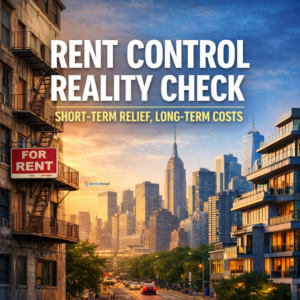
As rent prices continue to rise across the U.S., rent control is often brought to the table as a solution that promises immediate relief for struggling renters. At first glance, it can feel like a straightforward fix: cap rent increases, stabilize housing costs, and keep people in their homes.
But a new study released by the Pioneer Institute suggests the reality is far more complex.
According to the report, while rent control can provide short-term stability for some tenants, it may also create serious long-term challenges that ultimately worsen housing affordability for everyone else.
Why Rent Control Appeals to Renters
Rent control policies are typically designed to protect tenants from sharp and unpredictable rent increases. For households already stretched thin, this kind of protection can make a meaningful difference.
The study acknowledges that rent control can:
-
Help prevent displacement, especially for long-term residents
-
Offer predictability in monthly housing costs
-
Provide immediate relief in high-cost urban markets
In cities where rents have outpaced wages, these protections can offer peace of mind for renters who might otherwise be forced to move or downsize.
The Long-Term Tradeoffs Often Go Unnoticed
While the short-term benefits are real, the study warns that rent control can quietly introduce long-term problems that ripple throughout the housing market.
1. Reduced Housing Supply
One of the most significant concerns is that rent control can discourage new housing development. When developers see limited potential for returns, they may delay or abandon new projects altogether.
Over time, this means:
-
Fewer new rental units entering the market
-
Increased competition for existing housing
-
Higher rents for units not covered by rent control
Ironically, a policy meant to make housing more affordable can end up tightening supply and pushing prices higher elsewhere.
2. Declining Property Maintenance and Quality
When rent increases are restricted, property owners often face rising operating costs utilities, insurance, labor, and materials without the ability to offset them through rent adjustments.
As a result:
-
Maintenance may be deferred
-
Renovations may be postponed or canceled
-
Older buildings may deteriorate faster
This can lead to a gradual decline in housing quality, especially in rent-controlled buildings, impacting tenant safety and comfort.
3. Unequal Benefits Among Renters
Another key finding is that rent control does not necessarily help those who need it most.
Because rent-controlled units are limited:
-
Benefits often go to tenants who already secured housing early
-
Higher-income renters may occupy controlled units
-
Lower-income renters may struggle to find available housing at all
In many cases, the policy protects a specific group of tenants while leaving newcomers often younger or lower-income households with fewer options and higher prices.
What the Study Suggests Instead
Rather than relying solely on rent control, the study encourages policymakers to focus on solutions that increase housing supply and directly support renters.
These include:
-
Rental assistance or housing vouchers for income-qualified households
-
Zoning reforms that allow for higher-density housing
-
Streamlined permitting and development processes
-
Incentives for building affordable and workforce housing
By addressing affordability without discouraging development, these strategies aim to balance tenant protection with long-term market stability.
A Bigger Picture View of Housing Affordability
The takeaway from the study is not that rent control is inherently harmful but that it is not a standalone solution. Without complementary policies that encourage housing growth, rent control risks treating the symptoms while worsening the underlying problem.
True affordability requires:
-
More housing, not less
-
Policies that support both renters and property owners
-
Long-term planning instead of short-term fixes
As housing challenges continue to evolve, the study serves as an important reminder that well-intentioned policies must be evaluated not just for their immediate impact, but for their long-term consequences as well.
Source: BusinessWire
New Study Warns: Rent Control Offers Short-Term Relief, But Steep Long-Term Costs
https://www.businesswire.com/news/home/20250507676296/en/New-Study-Warns-Rent-Control-Offers-Short-Term-Relief-But-Steep-Long-Term-Costs